
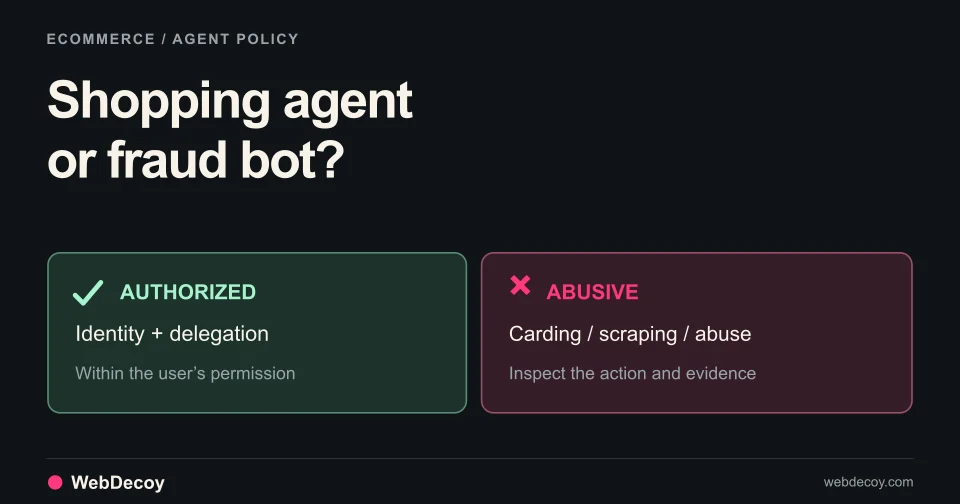
AI Shopping Bots vs Fraud Bots: How to Tell Them Apart
A merchant's guide to authorized AI shopping agents, checkout delegation, inventory scraping, carding, coupon abuse, and fake agent identities.
securityWhat abliterated means in AI models: how abliteration edits out the refusal direction, how it differs from uncensored LLMs, and which models are abliterated.
Published · Updated
So, what does “abliterated” mean in AI models? An abliterated model is a large language model that has been modified to stop refusing requests. The usual method finds a “refusal direction” in the model’s internal activations and edits the weights so that direction no longer drives its output, leaving the rest of the model largely in place. It describes how a checkpoint was changed, not a guarantee of unrestricted answers, improved reasoning, or unchanged accuracy.
In AI, abliteration concerns refusal behavior. A model can become more willing to answer without becoming better at answering correctly.
Abliteration (noun): A post-training technique that reduces an LLM’s refusal behavior by orthogonalizing its weights against a “refusal direction” found in its activations. The word combines ablate (to surgically remove) with obliterate, and was popularized by FailSpy’s abliterator library.
This is not a jailbreak or a prompt trick. Abliteration changes the model checkpoint itself, which is why the edited model behaves differently for every prompt, not just a crafted one.
| Term | What it describes | What it does not establish |
|---|---|---|
| Abliterated | A model modification associated with suppressing refusal-related directions | That every refusal disappears or capabilities stay unchanged |
| Uncensored | An informal label for fewer response restrictions, potentially achieved through different training or editing methods | Which technique was used or how the model was evaluated |
| Prompt-jailbroken | A model whose response has been influenced through a crafted input or context | That the underlying weights were changed |
| Locally hosted | Inference running on hardware controlled by the operator | That the model is abliterated or that the surrounding application sends no data elsewhere |
For a concrete comparison, FailSpy’s Llama 3 abliterated model card describes a weight-modified checkpoint. The Dolphin 2.9.4 model card describes an uncensored fine-tune. These are examples of different methods, not a current popularity ranking.
The name combines ablate with obliterate. FailSpy uses the term in the abliterator project, which provides tools for studying and modifying features in supported models. The dramatic name should not be read as a literal claim that all learned safety behavior has been deleted.
A language model’s internal activations influence what it generates, including whether it refuses a request. Researchers can compare those activations and investigate directions associated with a response behavior.
At a high level, researchers compare activations on prompt sets, identify candidate directions, apply an intervention, and evaluate the resulting behavior. Implementations differ in how they select directions and modify the model. A fixed layer range or a mandatory PCA step is not a universal definition of abliteration. Maxime Labonne’s implementation walkthrough gives one concrete account of the process and its evaluation.
Arditi and colleagues’ 2024 paper found a direction that mediated refusal across 13 tested chat models. Their interventions strongly changed refusal behavior with limited effects on other tested capabilities. That is evidence about the models and evaluations in the study, not proof that every model’s alignment is a removable switch.
A 2026 study by Joad and colleagues reports a more structured picture, with distinct directions associated with different refusal and non-compliance categories. Linear interventions can produce similar behavioral changes without fully describing that internal structure.
These findings support a useful distinction: changing observed refusal behavior does not demonstrate that every safety mechanism, limitation, or learned preference has been removed.
A fine-tune learns from additional training data. Weight-based abliteration directly edits an existing checkpoint using an identified direction. Both can change how often a model refuses, but their effects depend on the starting model and procedure.
An “uncensored” fine-tune may start from a model that already learned refusals. It is inaccurate to assume that such a model never learned to refuse. Likewise, a name ending in -abliterated is not enough to establish how the publisher produced it.
Refusal rate and answer quality are different measurements. More answers can include more incorrect answers. A modification can also change instruction following or task performance. The Labonne walkthrough discusses evaluating the edited model and using further training to address performance changes.
A useful evaluation compares the base and modified checkpoints using the same prompts, inference settings, and scoring criteria. Keep refusal frequency separate from correctness, coherence, and completion of legitimate tasks. Report the exact checkpoint revision so another person can reproduce the comparison.
Safety-training methods and post-training model edits operate at different stages and with different objectives. Abliteration should not be described as literally removing a conscience or as the mathematical inverse of a particular safety-training method. That metaphor obscures what was actually measured: changes in generated behavior.
These are the model families you will most often see abliterated. Names change quickly and this is not a download ranking; treat it as a map of where to look, then read each model card.
Meta’s Llama line is the most frequently abliterated family, thanks to its open weights and strong baseline. FailSpy’s Meta-Llama-3-8B-Instruct-abliterated-v3 is the usual reference example: it documents an edited Llama 3 checkpoint and its evaluation context. Community abliterated versions now tend to appear soon after each major Llama release.
Alibaba’s Qwen models are popular targets for their multilingual and coding ability, and community abliterated Qwen checkpoints are widely published on Hugging Face.
Mistral’s smaller models are common abliteration targets for local use on consumer hardware. Google’s Gemma models have been abliterated too.
DeepSeek’s reasoning models drew abliteration attention after their strong 2025 benchmark results.
Eric Hartford’s Dolphin models come up in the same conversations, but they are uncensored through fine-tuning, not abliteration. The Dolphin 2.9.4 Llama 3.1 8B model card describes a fine-tuned model; its uncensored label is not evidence of abliteration.
For any Llama, Qwen, Mistral, Gemma, or DeepSeek derivative, check the publisher’s stated method, base checkpoint, revision, evaluation, and applicable license. A shared family name does not mean two derivatives have the same behavior.
Start with a documented model card and its supported inference instructions. Hardware requirements depend on parameter count, precision, context length, and runtime; the word “abliterated” does not determine whether a model fits on your machine.
A model runner can simplify local inference, but check which checkpoint a registry entry actually packages. An uncensored Dolphin package demonstrates an uncensored fine-tune, not necessarily abliteration. Follow the selected package’s installation and model instructions rather than assuming any uncensored entry is interchangeable.
The model card should identify the original model, modification method, and example inference configuration. Pin the checkpoint revision and record any quantization when comparing outputs. Start from the documented FailSpy checkpoint if your goal is to inspect an explicit abliteration example.
For research into the mechanism, read the original paper, Labonne’s tutorial, and the abliterator repository. Tool support and intervention details vary by architecture; they do not establish compatibility with every released model.
Use the same benign evaluation prompts with the base and modified model. Include tasks that the base model already answers, tasks where it over-refuses, and tasks where a correct answer requires admitting uncertainty. Record the actual outputs instead of presenting an invented conversation as a benchmark.
Compare:
A lower refusal count is one result. It is not a substitute for the rest of that evaluation.
People study or deploy modified models for several reasons, with different evaluation needs.
Owning a checkpoint allows an operator to compare or modify its behavior. It does not guarantee deterministic instruction following. The surrounding application still needs explicit controls over tools, data, and actions.
Local inference can keep prompts within an operator-controlled environment. That property comes from the deployment, not abliteration. Check the runtime, telemetry, remote tools, and application integrations before claiming that no data leaves the machine.
Comparing original and modified checkpoints helps researchers investigate how behavior changes under an intervention. Preserve the original checkpoint, experimental settings, and evaluation records.
A writer may want different handling of fictional themes or fewer unnecessary refusals. Evaluate the quality of the actual writing, not just whether the model agrees to produce it.
Authorized testing may benefit from comparing refusal behavior on legitimate defensive tasks. The model’s willingness to respond does not establish the technical validity of its findings or the safety of its tool calls.
A web application usually observes an agent’s HTTP requests and browser interactions, not the weights of the model controlling it. There is no general “abliterated model” field in a TLS fingerprint or User-Agent string.
An agent framework can connect a model to a browser or API client. Its permissions, credentials, tool restrictions, and application logic determine what it can do. Reducing model refusals may change its responses, but does not by itself make it autonomous or grant access to a protected resource.
Local inference removes the need for an external inference provider on that part of the path. It does not make the agent invisible to the destination website. Requests still reach your application, and authentication failures, access patterns, and decoy interactions can remain observable.
A locally hosted model also need not be abliterated. Those are independent choices.
As a threat-model example, an operator could connect a modified model to a browser and use it to request content or interact with forms. That possibility is not evidence that a particular observed crawler uses such a model. Attribute only what your telemetry supports: the requests, claimed identity, verified network provenance where available, and resulting actions.
For a concrete defensive workflow, start with how to detect headless browsers and credential-stuffing detection. These address observable activity without relying on a claim about the agent’s underlying model.
Build controls around the actions you need to protect. Authentication, authorization, rate limits, request context, and detection signals each answer different questions. Behavioral analysis is one input, not the only reliable defense.
WebDecoy’s Bot Scanner collects browser-side evidence. The Edge Sensor observes traffic that a page script may not see, while decoy links record interactions with crawler-facing paths. For self-identified crawlers, use the crawler directory to inspect operator information and verification context.
These observations can support an investigation into automated activity. They cannot establish that the model behind it was abliterated.
The technique has research applications and can also be used in systems that cause harm. Evaluate the actual deployment, permissions, and behavior. Neither the label “uncensored” nor a lower refusal rate answers whether a particular use is reliable or appropriate.
Investigating automated traffic on your own site? See how Bot Scanner collects browser evidence.
An abliterated model has been modified to reduce refusal behavior, commonly by editing weights using a refusal-related direction in its activations. The label does not guarantee that every refusal is removed or that other capabilities are unchanged.
Abliteration is a post-training model-editing approach associated with suppressing refusal-related activation directions. Its effect depends on the model and intervention. Refusal rate, answer quality, and performance on intended tasks need separate evaluation.
Abliterated describes a modification method. Uncensored is a broader, informal description of a model's response behavior; it can refer to models trained or fine-tuned with fewer refusals as well as abliterated models. Check the model card to learn which method was used.
A prompt jailbreak changes the input to influence a model's response, while weight-based abliteration changes a checkpoint. Research also describes weight interventions as white-box jailbreaks, so the categories can overlap. You can restore an original checkpoint; abliteration is not inherently irreversible.
No such improvement follows from the label. Lower refusal rates do not establish better reasoning or factual accuracy. Compare the modified checkpoint with its base model on the tasks you need, including benign requests and unsupported answers.
No. Local hosting describes where inference runs; abliteration describes a model modification. An unmodified model can run locally, and an abliterated model can be hosted behind an API.
Modifying open-weight models is generally permitted by their licenses, but check the specific license, since some restrict use or redistribution. Using any model, abliterated or not, for an illegal purpose remains illegal: legality turns on how the model is used, not on the modification.
FailSpy's Meta-Llama-3-8B-Instruct-abliterated-v3 is the best-known reference example. Community abliterated variants are also published for Qwen, Mistral, Gemma and DeepSeek models. The Dolphin family is often mentioned alongside them, but it is uncensored through fine-tuning, not abliteration.
A merchant's guide to authorized AI shopping agents, checkout delegation, inventory scraping, carding, coupon abuse, and fake agent identities.
security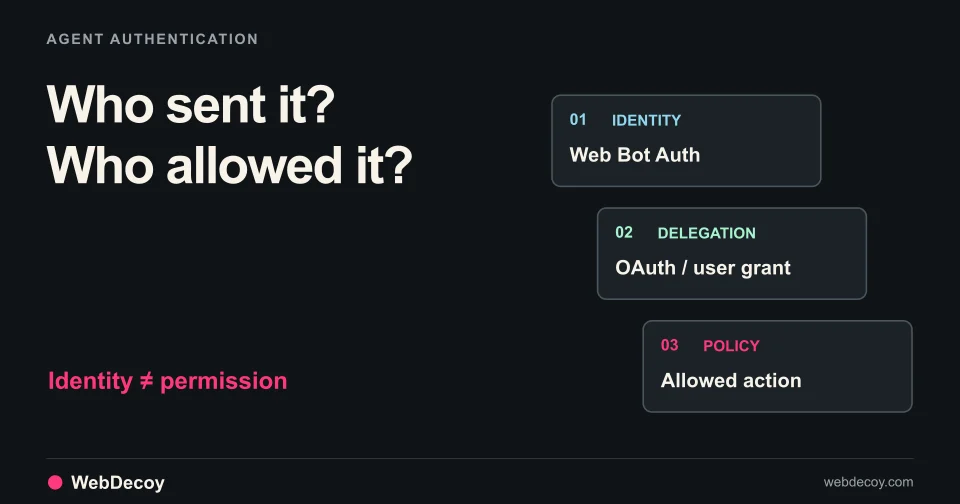
How Web Bot Auth, ARD, OAuth, and workload identity fit together to authenticate AI agents, preserve user delegation, and create auditable access.
security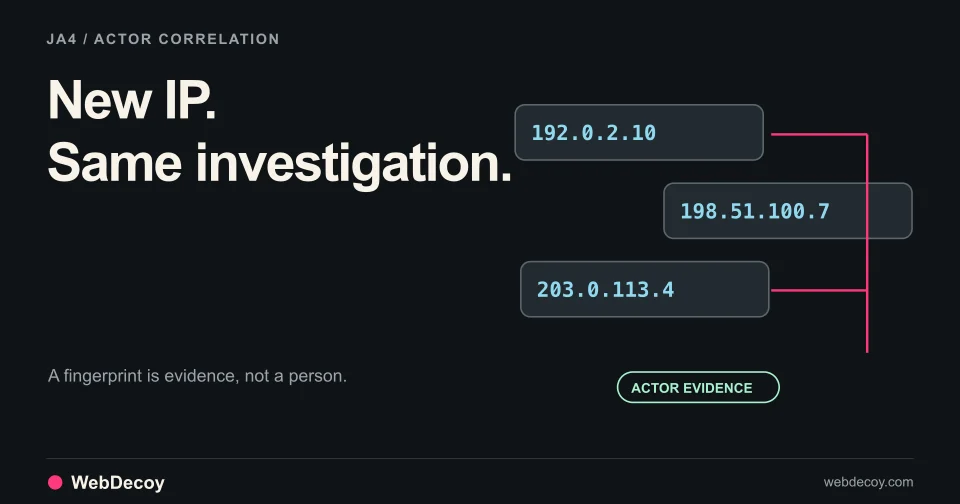
WebDecoy now tracks bots as persistent actors and pushes a JA4 rule to your AWS WAF or Cloudflare, blocking rotating scrapers across every IP they use.
securityLike this post? Share it with your friends!
Get a personalized demo from our team.