
API Security Honeypots: Catch Attackers First
How Endpoint Decoys detect API attacks: fake endpoints no legitimate client calls, for catching credential stuffing and injection probes.
securityUnderstand the difference between WAF and WAAP, and learn how WebDecoy's honeypot technology fits into a modern WAAP strategy.
Published · Updated
In the rapidly evolving landscape of cybersecurity, the tools we use to protect our digital assets are constantly changing. One of the most significant shifts in recent years has been the move from traditional Web Application Firewalls (WAF) to comprehensive Web Application and API Protection (WAAP) platforms.
But even the most advanced WAAP needs high-quality intelligence to be effective. That’s where WebDecoy comes in.
In this post, we’ll explore what a WAAP is, how it differs from a WAF, and how WebDecoy’s honeypot technology fits perfectly into a modern WAAP strategy.
The acronym WAAP stands for Web Application and API Protection. It is a modern, integrated suite of security services designed to protect web applications and their underlying Application Programming Interfaces (APIs) from a broad range of threats.
It is widely considered the evolution of the traditional Web Application Firewall (WAF).
A WAAP goes beyond the basic capabilities of a WAF by combining several security functions into a single, unified solution.
A complete WAAP solution typically integrates the following essential security functions:
The transition from WAF to WAAP was necessary because modern applications are increasingly built on microservices and APIs, which a traditional WAF wasn’t designed to fully handle.
| Feature | Traditional WAF | WAAP (Web App and API Protection) |
|---|---|---|
| Primary Focus | Traditional web apps (browser-based traffic) | Web Apps AND APIs (app-to-app traffic) |
| Key Threats Addressed | SQLi, XSS, Buffer Overflows (Application Layer 7) | All WAF threats + API Abuse, Advanced Bots, DDoS (Layers 3, 4, and 7) |
| Detection Method | Mostly Signature-Based (relies on known attack patterns) | Machine Learning (ML) and Behavioral Analysis (learns “normal” to catch new threats) |
| Architecture | Often on-premises appliance or basic cloud service | Typically Cloud-Native for high scalability and global threat intelligence |
In short, a WAAP provides a holistic, adaptive, and modern defense for all public-facing digital assets, offering a much broader and more intelligent level of protection than a standard WAF alone.
While WAAP solutions are powerful, they often rely on probabilistic methods (like machine learning) to detect bots. This can lead to false positives (blocking real users) or false negatives (letting sophisticated bots through).
WebDecoy complements your WAAP by providing deterministic, high-fidelity signals based on honeypot interactions.
A WAAP might guess that a user is a bot based on their mouse movement or request speed. WebDecoy knows a user is a bot because they interacted with a hidden honeypot element that no human can see.
You can feed WebDecoy’s detection data directly into your WAAP. And when WebDecoy confirms a rotating non-browser actor: a scraper or scripted client, not a real browser: it can push a JA4 rule to your WAF (AWS WAF or Cloudflare), blocking that tool across every IP it rotates through, not a single disposable address. Because the block keys on the TLS fingerprint rather than the IP, a proxy-rotating bot can’t slip it by renting a new address. For bots driving a real browser, WebDecoy hands your WAAP a persistent device identity and lets it make the challenge call. WebDecoy never blocks a browser fingerprint that legitimate users share.
WAAPs are great at blocking known attack patterns. WebDecoy excels at catching the “unknowns”. Custom scrapers and AI bots that mimic human behavior perfectly but can’t resist exploring hidden links.
A WAAP is an essential component of modern application security, providing broad protection against a wide array of threats. However, no single tool is a silver bullet.
By integrating WebDecoy with your WAAP, you add a layer of deception that turns the attacker’s curiosity against them, providing the high-confidence intelligence needed to block sophisticated bots without impacting legitimate users.
Ready to upgrade your security stack? Get started with WebDecoy for free and see what your WAAP might be missing.
How Endpoint Decoys detect API attacks: fake endpoints no legitimate client calls, for catching credential stuffing and injection probes.
security
A merchant's guide to authorized AI shopping agents, checkout delegation, inventory scraping, carding, coupon abuse, and fake agent identities.
security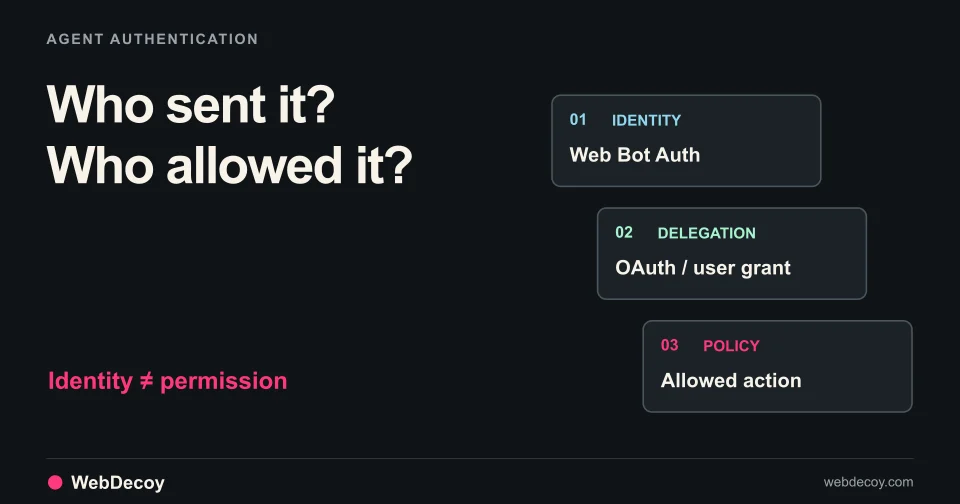
How Web Bot Auth, ARD, OAuth, and workload identity fit together to authenticate AI agents, preserve user delegation, and create auditable access.
securityLike this post? Share it with your friends!
Get a personalized demo from our team.