
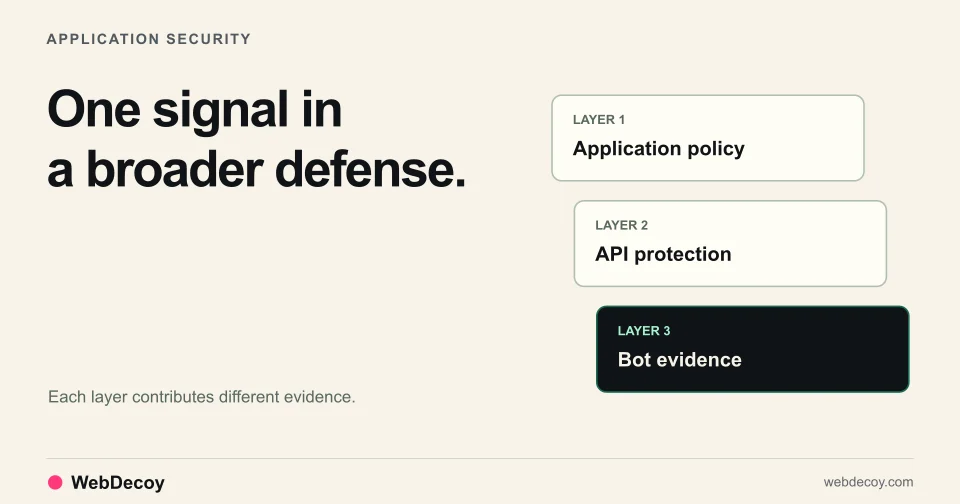
WebDecoy & WAAP: The Evolution of App Security
Understand the difference between WAF and WAAP, and learn how WebDecoy's honeypot technology fits into a modern WAAP strategy.
securityHow Endpoint Decoys detect API attacks: fake endpoints no legitimate client calls, for catching credential stuffing and injection probes.
Published · Updated
Here is a sobering reality: 95% of organizations experienced an API security incident in 2024. Attackers are not knocking on your front door anymore. They are probing your APIs, hunting for authentication endpoints, enumerating user data, and launching sophisticated injection attacks against your backend services.
The worst part? Most security teams only discover these attacks after the damage is done.
Today, we are announcing Endpoint Decoys, a new capability that fundamentally changes how you detect and respond to API threats. This is not incremental improvement. This is a paradigm shift in API security.
Your APIs are under siege. Every day, attackers deploy automated tools to:
Traditional API security tools respond reactively. They analyze logs after attacks occur. They generate alerts that drown in noise. They rely on signatures that sophisticated attackers easily evade.
The fundamental problem is this: by the time you detect an attack on a real endpoint, the attacker has already gathered intelligence, tested your defenses, and potentially exfiltrated data.
What if you could detect attackers before they ever reach a real endpoint?
Endpoint Decoys are advanced API honeypots that mimic real authentication, admin, and data endpoints. They look indistinguishable from legitimate APIs to attackers, but any request to these endpoints is, by definition, malicious.
Here is the key insight: legitimate users and applications never access endpoints that do not exist. A request to an Endpoint Decoy is, with very rare exceptions, an attack attempt or an automated probe.
When an attacker probes /api/admin/login or /api/v2/users/export and those endpoints are decoys, you have instantly identified a threat actor without them knowing they have been caught.
Unlike traditional honeypots that passively wait for attackers, Endpoint Decoys are intelligent trap systems that actively analyze attack patterns. For a comparison of honeypot vs CAPTCHA approaches, see our honeypot effectiveness guide.
Full HTTP Method Support Deploy decoys that respond to GET, POST, PUT, DELETE, and PATCH requests. Attackers cannot distinguish your decoys from real endpoints based on supported methods.
Automatic Attack Pattern Recognition Every request is analyzed in real-time for known attack signatures:
| Attack Type | Detection Method | Severity |
|---|---|---|
| SQL Injection | UNION attacks, comment sequences, encoded payloads | Critical |
| Command Injection | Shell commands, pipes, backticks, system calls | Critical |
| XXE (XML External Entity) | DOCTYPE declarations, entity references | Critical |
| Cross-Site Scripting | Script tags, event handlers, javascript: URIs | High |
| Path Traversal | Directory traversal patterns, encoded sequences | High |
| Insecure Deserialization | Serialized object patterns, magic bytes | High |
| Mass Assignment | Attempts to modify role, admin, or permission fields | Medium |
Full Payload Capture Optionally capture complete request bodies for forensic analysis. Understand exactly what attackers are sending, what data they are trying to exfiltrate, and what vulnerabilities they are attempting to exploit.
Integrated Threat Intelligence Every detection is enriched with AbuseIPDB reputation data, geographic information, ISP details, and usage type classification. Know immediately if the attacker is using a known malicious IP, VPN exit node, or botnet infrastructure.
Let me walk you through the detection flow when an attacker encounters your Endpoint Decoy.
An attacker running an API enumeration tool sends this request:
POST /api/v1/authenticate HTTP/1.1
Host: yourapp.com
Content-Type: application/json

{"username": "admin' OR '1'='1", "password": "password123"}
They are probing for a login endpoint while simultaneously testing for SQL injection.
Your Endpoint Decoy at /api/v1/authenticate intercepts the request. Because this is not a real endpoint in your application, you know with 100% certainty this is an attack.
WebDecoy’s detection engine analyzes the request:
Request Method: POST
Content-Type: application/json
Request Body Size: 62 bytes

Attack Signatures Detected:
  [CRITICAL] SQL Injection - OR statement in authentication field
  [HIGH] Authentication Abuse - Login endpoint probe

Authorization Header: Not PresentThe complete payload is captured:
{
  "timestamp": "2025-11-26T14:32:18.445Z",
  "source_ip": "185.220.101.42",
  "method": "POST",
  "path": "/api/v1/authenticate",
  "content_type": "application/json",
  "body": "{\"username\": \"admin' OR '1'='1\", \"password\": \"password123\"}",
  "attack_signatures": ["sql_injection", "auth_probe"],
  "severity": "critical"
}Based on your configured response actions:
The attacker never touched your real infrastructure. They revealed their presence, their techniques, and their intent before getting anywhere near actual data.
Effective decoy placement requires understanding attacker behavior. Here are the highest-value deployment strategies:
Credential stuffing is one of the most common API attacks. Deploy decoys at paths attackers expect to find:
/api/auth/login/api/v1/authenticate/api/admin/signin/api/oauth/token/api/sessionAny request to these fake authentication endpoints reveals an attacker attempting credential stuffing or brute force attacks.
Attackers probe for endpoints that expose user data, typically early in their reconnaissance:
/api/users/api/admin/users/api/v2/accounts/graphql (especially powerful for GraphQL introspection attempts)/api/customers/exportAutomated vulnerability scanners have predictable patterns. Catch them with decoys at:
/api/admin/export/api/backup/api/debug/api/config/api/internal/status/api/.envThese paths attract scanners looking for misconfigurations, debug endpoints, or exposed sensitive data.
Attackers often probe for old API versions hoping to find unpatched vulnerabilities:
/api/v0/users/api/v1/admin (when your real API is v3)/api/beta/internalThis is critical to understand: Endpoint Decoys keep false positives rare by design, because no legitimate client has a reason to call an endpoint your application never links to.
Think about what that means:
Compare this to traditional WAF rules or anomaly detection systems that generate hundreds of alerts daily, most of which are false positives. Security teams become desensitized. Real attacks get lost in the noise.
Endpoint Decoys flip this dynamic. When you get an alert, something went looking for an endpoint that should not exist.
Endpoint Decoys integrate seamlessly with WebDecoy’s existing capabilities and your broader security infrastructure:
Detections from Endpoint Decoys feed directly into bot score calculations:
All existing WebDecoy response actions work with Endpoint Decoys:
Every detection is automatically enriched with:
Deploying your first Endpoint Decoy takes less than five minutes:
/api/auth/login)For programmatic deployment, create the decoy through the REST API (see the API reference and the endpoint decoy docs):
POST https://api.webdecoy.com/api/decoys
Authorization: Bearer sk_live_your_api_key

{
  "organization_id": "your-org-uuid",
  "name": "Admin Login Honeypot",
  "path": "/api/admin/login",
  "trigger_action": "log",
  "decoy_type": "endpoint",
  "allowed_methods": ["POST"],
  "capture_body": true,
  "expected_content_type": "application/json"
}API attacks are not slowing down. They are accelerating. Attackers are using AI to generate more sophisticated payloads. They are leveraging residential proxy networks to evade IP-based blocking. They are automating reconnaissance at scale.
Reactive security cannot keep up.
Endpoint Decoys represent a fundamental shift toward proactive defense. Instead of waiting for attacks to hit your real infrastructure, you are deploying intelligent traps that reveal attacker presence, capture their techniques, and enable immediate response.
The attacker thinks they are probing your API. In reality, you are studying them.
This intelligence advantage is transformative. You learn what endpoints attackers target. You understand their attack patterns. You identify their infrastructure. And you block them before they ever threaten real data.
Every hour you wait, attackers are probing your APIs. They are testing for vulnerabilities. They are enumerating your data. They are building the intelligence they need for a successful attack.
Endpoint Decoys give you the power to detect them first.
Get started with Endpoint Decoys and transform your API security from reactive to proactive.
Stop waiting for attacks to succeed. Start detecting them before they begin.
Deploy your first Endpoint Decoy now
Have questions about Endpoint Decoys? Contact our security team for implementation guidance.
Related Reading:
Understand the difference between WAF and WAAP, and learn how WebDecoy's honeypot technology fits into a modern WAAP strategy.
security
A merchant's guide to authorized AI shopping agents, checkout delegation, inventory scraping, carding, coupon abuse, and fake agent identities.
security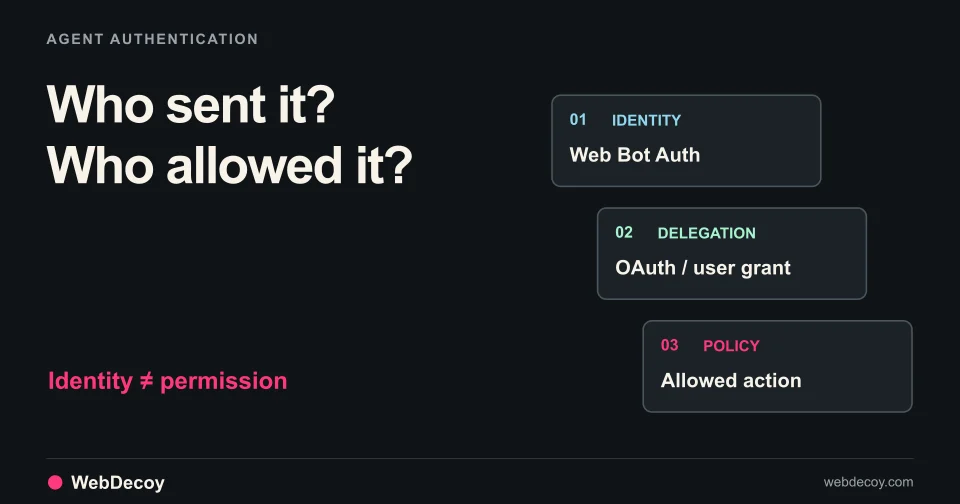
How Web Bot Auth, ARD, OAuth, and workload identity fit together to authenticate AI agents, preserve user delegation, and create auditable access.
securityLike this post? Share it with your friends!
Get a personalized demo from our team.