DETECT
& BLOCK Bots by Identity

Four sensors, one actor. Honeypot decoys catch bots with zero false positives. Behavioral analysis catches headless browsers and automation frameworks. An edge sensor catches the crawlers that never run JavaScript at all. Every detection resolves to a single actor identity that survives IP rotation — so one decoy hit follows it across every address it rotates to.

14 day free trial · No credit card required

Why WebDecoy?

Honeypot Deception

Invisible decoy links and fake API endpoints that no real visitor can reach. When one is touched you have a confirmed bot—not a score, not a guess. Zero false positives, by construction.

Behavioral Analysis

Bot Scanner detects headless browsers, automation frameworks, and sophisticated bots that evade traditional detection—mouse entropy, interaction timing, canvas and WebGL signals.

Edge Sensor

A one-click Cloudflare Worker that catches the crawl pass itself—Googlebot, GPTBot, ClaudeBot, and curl. The clients that never run JavaScript, and so were never visible to a page tag.

Persistent Actor Identity

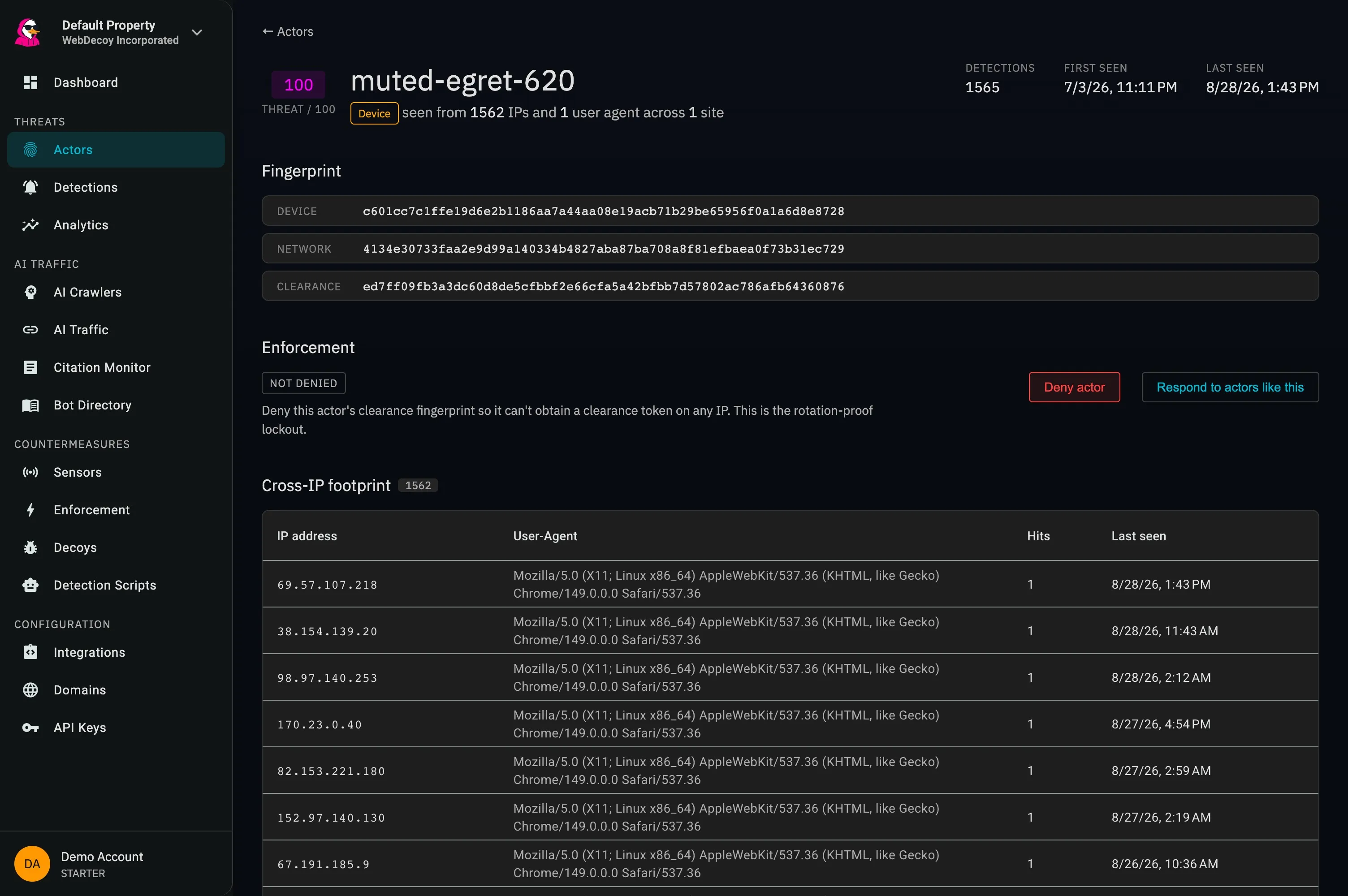
JA4 TLS and device fingerprints tie thousands of rotating IPs back to one actor. Catch it once and the detection follows it everywhere—IP rotation stops being an escape hatch.

Stop AI Scrapers

Detect and block GPTBot, ClaudeBot, Perplexity, and 20+ AI crawlers. Protect your content from unauthorized training data harvesting.

Verified Crawlers

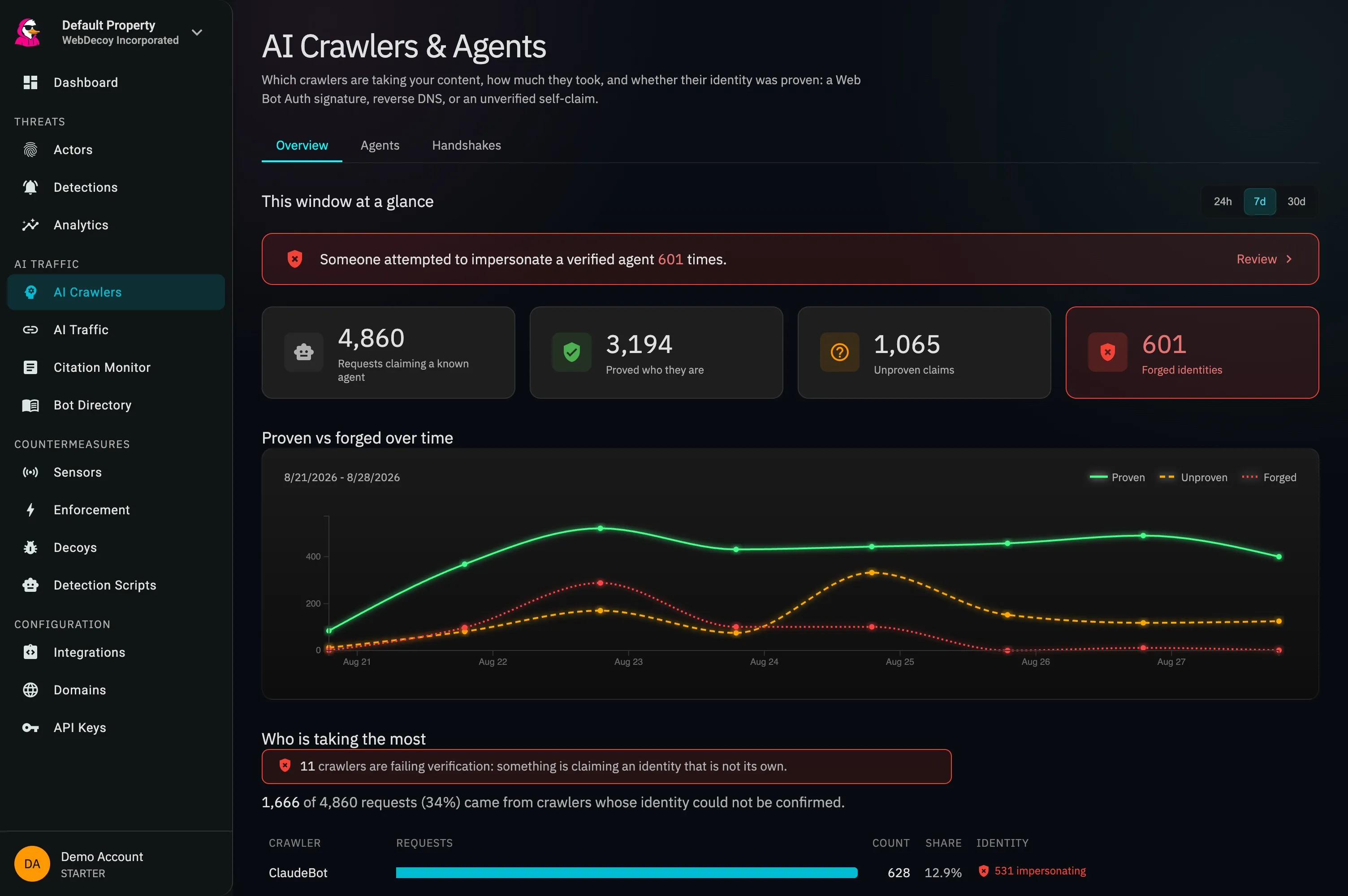
“Allow Googlebot” stops meaning “trust a header.” Crawlers are verified against published IP ranges with forward-confirmed reverse DNS, plus Web Bot Auth signatures from operators that sign. Anything claiming an identity it can’t prove is scored as impersonation.

Enforcement You Approve

Monitor mode builds a reviewable deny-list with the evidence attached—which decoy, which path, when. You approve it, then clearance revocation and auto-expiring WAF rules act on exactly what you approved.

SDK, API & Webhooks

Embed detection with the Node SDK or JavaScript tag, drive everything through the REST API, and push events to Slack, SIEM, or PagerDuty.

LLM Referral Tracking

See visitors arriving from ChatGPT, Perplexity, Gemini, and 8 more AI platforms. Track the AI search traffic your analytics is missing.

New: Cloudflare Edge Sensor

See the Crawlers JavaScript Can’t

Googlebot’s crawl pass is plain HTTP with no DOM. GPTBot and ClaudeBot never run JavaScript at all. A page tag is structurally incapable of seeing them—so we put a sensor in front of your origin. One click on Cloudflare.

  • Install and uninstall in one click—no wrangler, no YAML
  • Detects the crawl pass, scripted clients, and forged crawler identities
  • Enforces at the edge—denied clients stopped before your origin
  • Fails open by design—it cannot take your site down
Explore the Edge Sensor
Edge Worker Detection
GET /robots.txt HTTP/1.1
User-Agent: Googlebot/2.1 (+http://www.google.com/bot.html)
CF-Connecting-IP: 142.111.58.63

// flags: known_crawler_ua, crawler_path
// forwarded to WebDecoy, response untouched

— server-side verification —

// rDNS: acedatacenter.com
// ASN: not Google (15169)
// verdict: agent_impersonation
New Feature

Endpoint Decoys: API Honeypots

Go beyond web scraper detection. Deploy fake API endpoints that catch credential stuffing attacks, SQL injection attempts, and API enumeration before attackers reach your real infrastructure.

  • Detect SQL injection, XSS, XXE & more
  • Zero false positives - only attackers trigger
  • Full forensic payload capture
  • AbuseIPDB threat intelligence integration
Explore Endpoint Decoys
Attack Detection
POST /api/admin/login HTTP/1.1
Content-Type: application/json

{
  "username": "admin' OR '1'='1",
  "password": "' UNION SELECT * --"
}

// DETECTED: SQL Injection
// Severity: Critical
// Actor blocked at WAF by JA4 (every IP)
New: Geographic Consistency

Catch VPNs, Proxies & Location Spoofing

Fraudsters hide behind VPNs and proxies. Our Geographic Consistency Detection exposes them by analyzing timezone, language, and IP mismatches in real-time.

  • Timezone vs GeoIP continent-level mismatch detection
  • Browser language vs expected country language analysis
  • VPN likelihood scoring (0-100 consistency score)
  • Stop credential stuffing and payment fraud at the source
Learn About Geographic Consistency
Geographic Consistency Detection
{
  "geo_consistency": {
    "consistency_score": 35,
    "is_vpn_likely": true,
    "flags": [
      "timezone_mismatch",
      "language_mismatch"
    ]
  },
  "analysis": {
    "browser_tz": "Asia/Shanghai",
    "geoip_tz": "America/New_York",
    "languages": ["zh-CN", "zh"],
    "expected": ["en"]
  },
  "verdict": "block"
}
New: AI Referral Analytics

See Your AI Search Traffic

When someone asks ChatGPT about your product and clicks through, where does that show up in your analytics? Nowhere — until now. WebDecoy tracks LLM referral traffic across 11 AI platforms.

  • Dashboard with top AI platforms, trends, and landing pages
  • ChatGPT, Perplexity, Gemini, Claude, DeepSeek, Copilot, and more
  • Zero configuration — works automatically with the detection script
  • Score of 0 — these are human visitors, not bots
Learn About LLM Referral Tracking
LLM Referral Detection
{
  "source": "llm_referral",
  "score": 0,
  "flags": ["llm_referral"],
  "referrer": "https://chat.openai.com/",
  "platform": "chatgpt",
  "landing_page": "/pricing",
  "timestamp": "2026-02-07T14:23:00Z"
}

// Human visitor from AI search
// Not a bot — analytics only
Bot Scanner

Behavioral Analysis That Catches Every Bot

Bot Scanner goes beyond honeypots with real-time behavioral analysis. Detect headless browsers, automation frameworks, and AI crawlers before they scrape a single page.

  • Detect Puppeteer, Playwright, Selenium with 95%+ accuracy
  • JA4 TLS fingerprinting IDs the actor behind rotating IPs
  • Mouse entropy and interaction timing analysis
  • Sub-second detection to response automation
Explore Bot Scanner Features
Bot Scanner Detection
{
  "detection_source": "bot_scanner",
  "signals": {
    "headless_browser": true,
    "automation_framework": "puppeteer",
    "mouse_entropy": 0.12,
    "webgl_spoofed": true
  },
  "threat_score": 92,
  "actor": {
    "fingerprint_tier": "device",
    "distinct_ips_seen": 5183,
    "rotating": true
  },
  "ip_enrichment": {
    "is_datacenter": true,
    "abuse_score": 87
  },
  "action": "blocked",
  "latency_ms": 47
}
New: Enforcement

A Queue of Judgments, Not a Config Screen

Most bot products answer “why did you think this was a bot?” with an opaque ID or a score. A honeypot hit is explainable in one sentence—and that sentence is the whole credibility of the product.

  • Monitor mode builds the deny-list while blocking nothing
  • Review each entry with its evidence, then approve or dismiss
  • Enforce is a gate, not a toggle—four preconditions, or it refuses
  • Outcome counters are event counts, never inventory dressed as results
See Enforcement & Response
Decision Queue
[pending]  9f3c4a71
           device · 40 IPs · 3 sites · 2h ago

why: requested /wp-admin-backup.php at 03:41:12
     — a path that exists nowhere on your site,
     linked only from a hidden element on /pricing

[ Deny — 30 days ]  [ Dismiss ]  [ Open actor → ]

// nothing in the queue blocks traffic
// until you approve it
Agent Identity

“Allow Googlebot” Shouldn’t Mean “Trust a Header”

Copying the GPTBot user-agent string is one line of code. WebDecoy makes a crawler earn the allowlist—and scores anything claiming an identity it can’t prove as impersonation.

  • Published IP ranges plus forward-confirmed reverse DNS—how Googlebot is actually verified
  • Agent impersonation as a first-class detection class
  • Web Bot Auth (RFC 9421) signature verification, ready as operators adopt signing
  • Graded human trust—require a minimum level per route
Explore Agent Identity
Crawler Verification
User-Agent: Googlebot/2.1
Source IP:  66.249.66.1

rDNS       → crawl-66-249-66-1.googlebot.com
forward    → 66.249.66.1  ✓ confirmed
ASN        → 15169 (Google)  
// verified_status: verified

— same user agent, different source —

rDNS       → (none)
ASN        → M247 Europe SRL  
// verified_status: spoofed
// detection: agent_impersonation

Multi-Layer Bot Defense

WebDecoy combines invisible honeypot decoys, behavioral analysis, and an edge sensor that sees the crawlers a page tag never can. Detect when AI bots visit your website, then block, poison their training data, or trigger your security automation.

Get Started for Free Opens in a new tab

Connects to Your Entire Security Stack

WebDecoy integrates with the tools you already use. Install the edge sensor on Cloudflare in one click, push composite, auto-expiring enforcement rules to your Cloudflare or AWS WAF, stream metrics to your SIEM, and automate response across your infrastructure.

Cloudflare
Vercel
Datadog
AWS WAF
Akamai
Fastly
Webhooks
SOC Integration

MITRE ATT&CK Threat Mapping

Every detection automatically maps to MITRE ATT&CK tactics and techniques. Speak the same threat language as your SOC team, SIEM, and compliance frameworks.

TA0043

Reconnaissance

TA0006

Credential Access

TA0002

Execution

TA0007

Discovery

See Full ATT&CK Mapping
ATT&CK-Enriched Alert
{
  "detection": "credential_stuffing",
  "mitre_attack": {
    "tactics": ["TA0001", "TA0006"],
    "techniques": ["T1078", "T1110.004"]
  },
  "technique_names": [
    "Valid Accounts",
    "Credential Stuffing"
  ],
  "threat_score": 94
}

Made for Your Industry

News Publishers

Protect articles from AI summarization

E-commerce

Protect pricing and inventory data

SaaS Companies

Protect documentation and code

API-First Companies

Detect API attacks & credential stuffing

Agencies

Manage multiple client sites

What is WebDecoy?

WebDecoy is a bot detection platform built on four sensors with deliberately different blind spots. Honeypot decoys—invisible links and fake API endpoints—catch bots with zero false positives, because no real visitor can reach them. Bot Scanner adds behavioral analysis and device fingerprinting for headless browsers and automation frameworks. The edge sensor catches everything that never opens a browser at all: Googlebot’s crawl pass, GPTBot, ClaudeBot, and curl. And agent identity verifies the crawlers you want to allow, so “allow Googlebot” stops meaning “trust a header.”

Every detection resolves to a persistent actor identity—JA4 TLS and device fingerprints that tie thousands of rotating IPs back to one client. Catching an actor once means catching it everywhere, which is what makes IP rotation stop working as an escape hatch. Endpoint Decoys extend the same approach to your APIs, catching credential stuffing, SQL injection, and enumeration attempts.

Enforcement is a decision you make, not a switch you flip. Monitor mode builds a reviewable deny-list with the evidence attached—which decoy, which path, when—and blocks nothing until you approve it. Then session clearance revocation handles browsers and composite, auto-expiring rules in the Cloudflare or AWS WAF you already own handle datacenter bots. Integrate with Cloudflare, AWS WAF, Splunk, Elastic, and Datadog via SDK, REST API, or native integrations, with every detection mapped to MITRE ATT&CK tactics for your SOC.

Ready to stop bots before they attack?

Get a personalized demo and see how WebDecoy can protect your specific use case.

Schedule a Demo

Join Companies Protecting Their Content

Start with our free plan. Scale to enterprise as you grow.

14 day free trial · No credit card required