
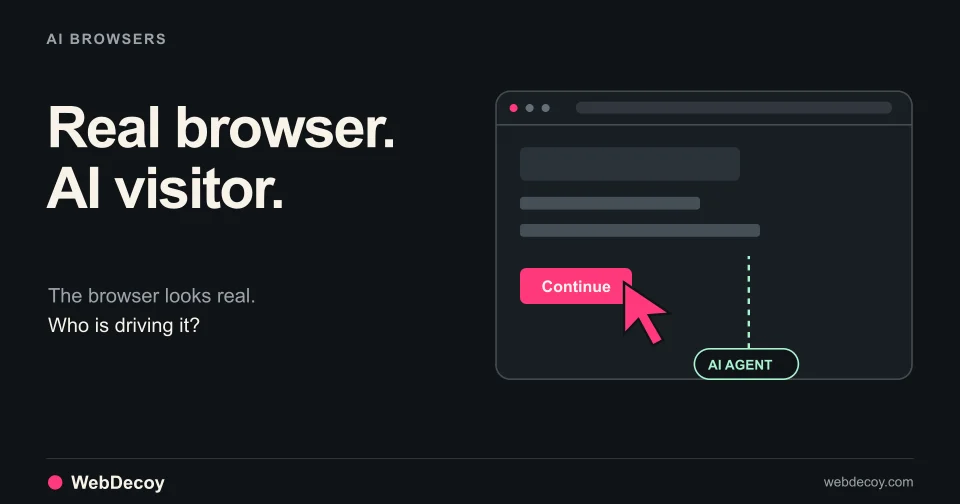
A Real Browser No Longer Proves a Human Is Visiting
Cloud-hosted AI agents reach forms and signup flows in full browsers. What the latest traffic research means for bot detection on your site.
bot-detectionStop AI crawlers from scraping your content for training data. Detect GPTBot, ClaudeBot, CCBot, and 20+ AI scrapers with behavioral analysis and honeypots.
Published · Updated
Your content is being scraped right now. Not by traditional search engines. By AI companies building the next generation of language models. Every blog post, product description, and technical document on your site is potential training data for GPT-5, Claude 4, and dozens of other AI systems.
The question isn’t whether AI scrapers are visiting your site. It’s whether you can detect them, and what you’re going to do about it.
AI companies need vast amounts of web content to train their models. To get it, they deploy sophisticated crawlers that harvest text from millions of websites. Some announce themselves honestly. Others disguise their identity to avoid blocks.
Here are the AI scrapers you should know about:
| Bot Name | Company | User Agent Contains | Announced |
|---|---|---|---|
| GPTBot | OpenAI | GPTBot | Yes |
| ChatGPT-User | OpenAI | ChatGPT-User | Yes |
| ClaudeBot | Anthropic | ClaudeBot | Yes |
| Claude-Web | Anthropic | Claude-Web | Yes |
| CCBot | Common Crawl | CCBot | Yes |
| PerplexityBot | Perplexity | PerplexityBot | Yes |
| Amazonbot | Amazon | Amazonbot | Yes |
| Google-Extended | Google-Extended | Yes | |
| FacebookBot | Meta | FacebookBot | Yes |
| Bytespider | ByteDance | Bytespider | Yes |
| Applebot-Extended | Apple | Applebot-Extended | Yes |
| cohere-ai | Cohere | cohere-ai | Yes |
| Diffbot | Diffbot | Diffbot | Yes |
| Omgilibot | Webz.io | Omgilibot | Yes |
| YouBot | You.com | YouBot | Yes |
But here’s the problem: sophisticated scrapers don’t announce themselves. They spoof legitimate browser user agents and mimic human behavior.
The standard advice for blocking AI scrapers is to update your robots.txt:
User-agent: GPTBot
Disallow: /

User-agent: ClaudeBot
Disallow: /

User-agent: CCBot
Disallow: /
This approach has three fatal flaws:
Robots.txt is a gentleman’s agreement. Well-behaved bots respect it. Malicious scrapers ignore it completely. There’s no technical mechanism to force compliance.
Any scraper can change its user agent string. A Python script with requests library takes one line to impersonate Chrome:
headers = {'User-Agent': 'Mozilla/5.0 (Windows NT 10.0; Win64; x64) Chrome/120.0.0.0'}
response = requests.get('https://yoursite.com', headers=headers)
Now your robots.txt block is useless: the scraper looks like a regular browser.
By the time you add a new bot to your robots.txt, it’s already scraped your site. You’re always playing catch-up.
The conclusion is clear: robots.txt is a starting point, not a solution. You need active detection.
Even when AI scrapers disguise their identity, their behavior reveals them. Here’s what to look for:
AI scrapers exhibit distinctive patterns:
Detection approach:
Normal user session:
  / → /about → /pricing → /contact
  Assets loaded: 47 (CSS, JS, images)
  Time between pages: 15-90 seconds (reading)

AI scraper session:
  /blog/post-1 → /blog/post-2 → /blog/post-3 → /blog/post-4
  Assets loaded: 0
Time between pages: 0.5-2 seconds (consistent)Every HTTP client has a unique TLS fingerprint based on how it negotiates the SSL/TLS handshake. This fingerprint. Captured as a JA3 or JA4 hash, reveals the true identity of the client.
The key insight: A request claiming to be Chrome but presenting a Python requests TLS fingerprint is lying.
| Claimed User Agent | TLS Fingerprint | Verdict |
|---|---|---|
| Chrome/120 | Chrome JA3 hash | Legitimate |
| Chrome/120 | Python-requests JA3 | Spoofed - Block |
| Chrome/120 | curl JA3 | Spoofed - Block |
| Chrome/120 | Node.js JA3 | Spoofed - Block |
WebDecoy’s TLS fingerprinting capabilities catch these mismatches automatically.
AI scrapers typically don’t execute JavaScript. They fetch raw HTML and extract text. This creates a detectable signal.
Detection technique:
// Detection snippet
document.addEventListener('DOMContentLoaded', function() {
  fetch('/api/beacon', {
    method: 'POST',
    body: JSON.stringify({ js: true, ts: Date.now() })
  });
});
Real browsers execute this. Scrapers don’t.
The most reliable AI scraper detection method: invisible links that only bots follow.
How it works:
display:none or positioned off-screen)<!-- Invisible to humans, visible to scrapers parsing HTML -->
<a href="/content-archive-2024" style="position:absolute;left:-9999px;">Archive</a>When a scraper follows this link, you’ve caught it with 100% certainty.
Learn more about this approach in our endpoint decoys guide.
AI scrapers often run from:
Cross-reference the claimed location (from headers or timezone) with the actual IP geolocation. Mismatches indicate spoofing.
Our geographic consistency detection catches these discrepancies.
Start with robots.txt to block well-behaved AI crawlers:
# Block AI training crawlers
User-agent: GPTBot
User-agent: ChatGPT-User
User-agent: ClaudeBot
User-agent: Claude-Web
User-agent: CCBot
User-agent: PerplexityBot
User-agent: Amazonbot
User-agent: Google-Extended
User-agent: FacebookBot
User-agent: Bytespider
User-agent: Applebot-Extended
User-agent: cohere-ai
User-agent: Diffbot
User-agent: Omgilibot
User-agent: YouBot
User-agent: anthropic-ai
User-agent: Scrapy
User-agent: img2dataset
Disallow: /

# Allow legitimate search engines
User-agent: Googlebot
User-agent: Bingbot
User-agent: DuckDuckBot
Allow: /
Limitation: Only stops honest bots.
Block requests with known AI scraper user agents at the web server level:
Nginx:
if ($http_user_agent ~* (GPTBot|ClaudeBot|CCBot|PerplexityBot|Bytespider)) {
    return 403;
}
Apache:
RewriteEngine On
RewriteCond %{HTTP_USER_AGENT} (GPTBot|ClaudeBot|CCBot|PerplexityBot|Bytespider) [NC]
RewriteRule .* - [F,L]
Cloudflare: Create a WAF rule:
(http.user_agent contains "GPTBot") or
(http.user_agent contains "ClaudeBot") or
(http.user_agent contains "CCBot")
→ Block
Limitation: Trivially bypassed by changing user agent.
For comprehensive protection, deploy behavioral detection:
rateLimit rule for throttling, or a decoy link’s Poison action to return decoy content you configureWebDecoy detects AI scrapers through:
Result: Catch both announced and disguised AI scrapers, with honeypot hits that legitimate visitors don’t produce.
Detection is only half the battle. You need a response strategy.
The simplest approach, return 403 Forbidden or drop the connection.
Pros: Immediate protection Cons: Scrapers may retry from different IPs
Allow some access but throttle aggressive crawling.
Normal users: Unlimited
Detected scrapers: 10 requests/minute, then block
Pros: Less aggressive, catches IP rotation Cons: Still allows some scraping
Return different content to detected scrapers:
Pros: Doesn’t alert scrapers they’re detected Cons: More complex to implement
Slow down responses dramatically for detected scrapers:
if is_ai_scraper(request):
    time.sleep(30)  # 30-second delay
    return minimal_response()
Pros: Wastes scraper resources, discourages continued crawling Cons: Keeps connections open longer
For persistent, commercial-scale scraping:
Note: Legal approaches are slow and expensive. Technical prevention is more practical.
Your written content is prime AI training data. Protect it with:
/blog/* pathsE-commerce content is valuable for AI product understanding:
Technical docs are heavily targeted:
Forums, reviews, and comments are scraped for training:
Set up ongoing monitoring for AI scraping activity:
Send AI scraper detection events to your SIEM for correlation:
{
  "event_type": "ai_scraper_detected",
  "timestamp": "2025-12-08T14:30:00Z",
  "source_ip": "52.12.34.56",
  "user_agent": "Mozilla/5.0 Chrome/120.0.0.0",
  "true_identity": "python-requests/2.28",
  "detection_method": "tls_fingerprint_mismatch",
  "pages_accessed": 47,
  "honeypot_triggered": true
}
See our SIEM integration guide for setup instructions.
AI scraping raises complex legal questions:
Your content is copyrighted. Unauthorized copying for commercial AI training may constitute infringement. However, “fair use” arguments are being tested in courts.
Key cases to watch:
Your ToS can prohibit automated scraping. While not always enforceable against anonymous scrapers, it strengthens legal position against known companies.
robots.txt is not legally binding, but ignoring it may be evidence of bad faith in copyright litigation.
Recommendation: Maintain clear ToS prohibiting AI training use, implement technical protections, and document scraping activity for potential legal action.
The cat-and-mouse game will intensify:
Expect new standards for AI data collection:
AI scrapers are harvesting web content at unprecedented scale. Your blog posts, documentation, and product descriptions may already be training the next generation of language models, without your consent or compensation.
You have options:
The right choice depends on your content’s value and your tolerance for unauthorized use.
For most publishers and businesses, active detection is the answer. It’s the only approach that catches scrapers who don’t play by the rules.
WebDecoy provides the detection capabilities you need:
Your content is valuable. Protect it.
Have questions about AI scraper detection? Contact our team or explore our comparison with other bot detection solutions.
Cloud-hosted AI agents reach forms and signup flows in full browsers. What the latest traffic research means for bot detection on your site.
bot-detection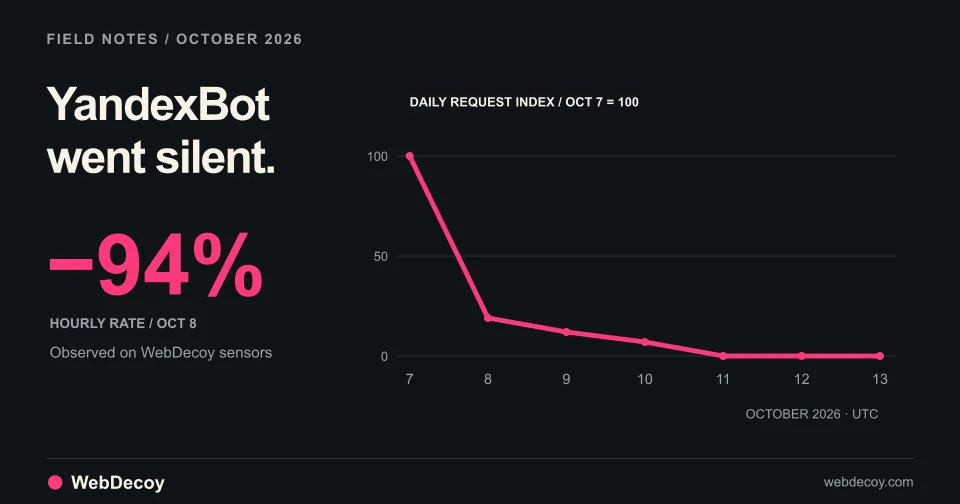
After reported strikes on Yandex data centers, YandexBot traffic on our sensors fell 94% on October 8 and stopped on October 10. Googlebot didn't move.
bot-detection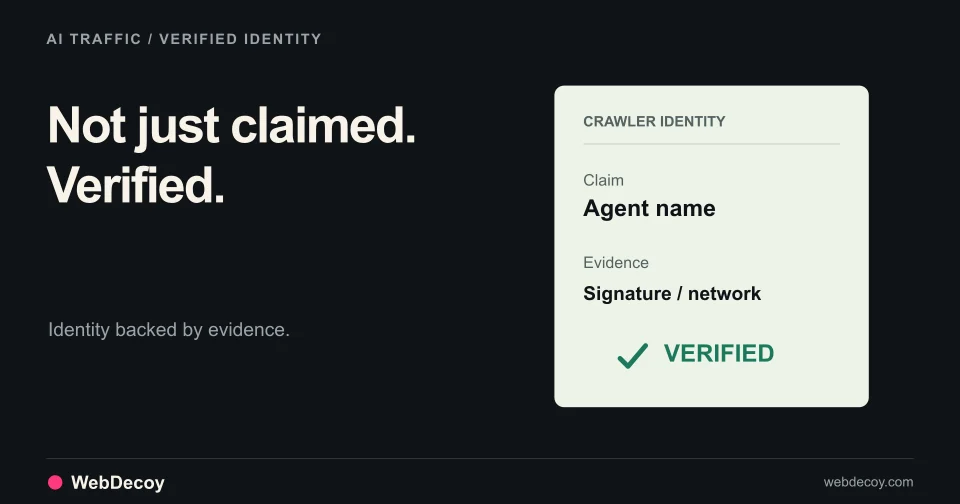
See which AI crawlers proved who they are, which pages AI assistants fetched for real people, and how many visitors each AI product sent back.
bot-detectionLike this post? Share it with your friends!
Get a personalized demo from our team.