
Login automation blends into distributed traffic
Credential attacks can spread requests across many addresses. Available actor and browser signals provide context for an investigation when paired with your authentication logs and account safeguards.
Bot protection for Financial Services & Fintech
Bring bot evidence into login, application, and API investigations. Keep your team in control of the response.
Discuss Your DeploymentThe business impact
Credential attacks can spread requests across many addresses. Available actor and browser signals provide context for an investigation when paired with your authentication logs and account safeguards.
Scripted applications create review work before a person has assessed the applicant. Add automation checks to form workflows while keeping identity verification and application decisions in the systems responsible for them.
Automated clients test administrative paths and APIs for useful responses. Endpoint decoys can capture that exploration in isolated routes, giving security teams a specific request to investigate.
Inside WebDecoy
This real enforcement-policy screen shows how WebDecoy separates observation from response configuration. Use a reviewed rollout for sensitive workflows, and assess deployment settings against your organization’s operational requirements.
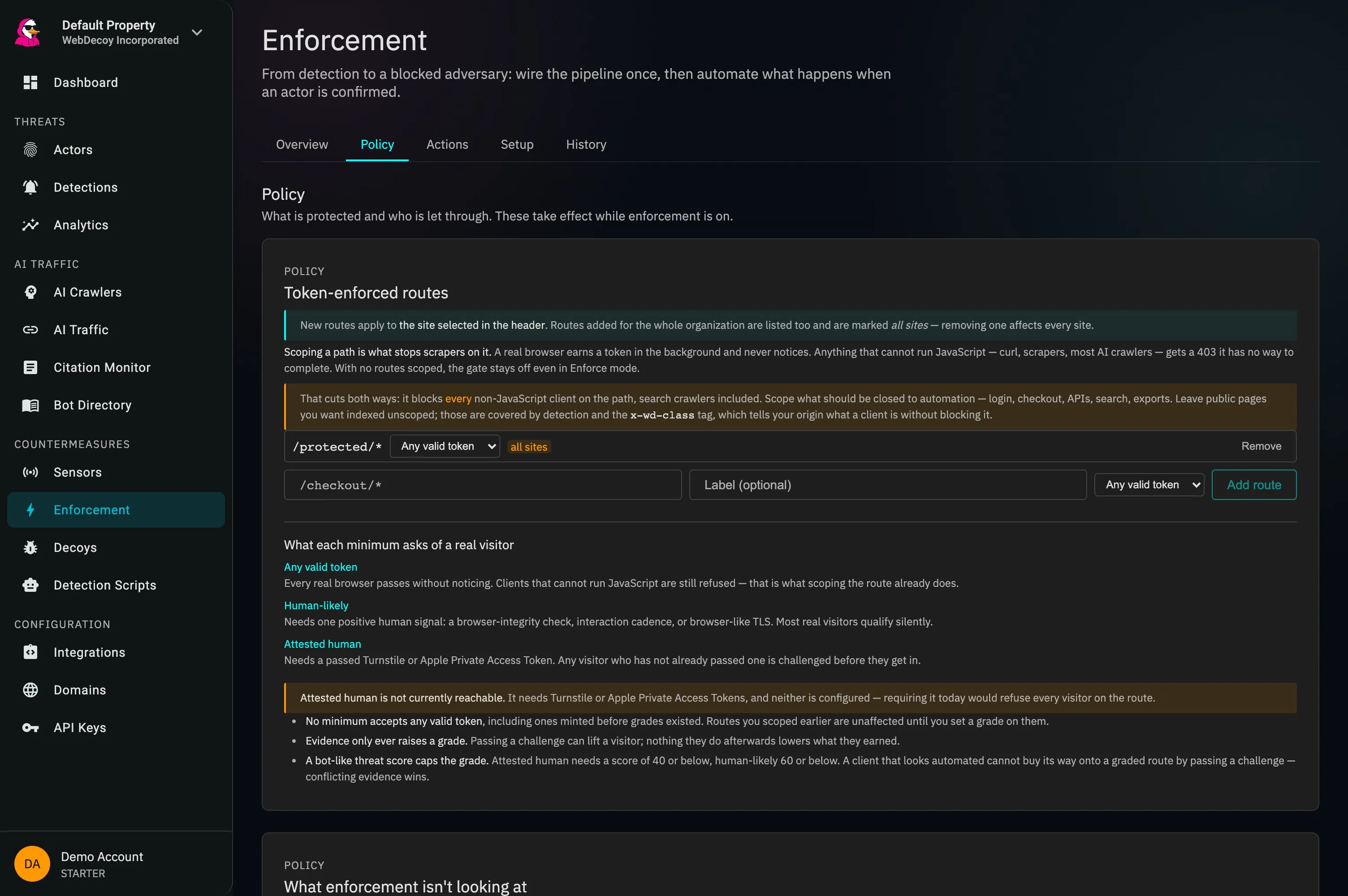
Actual WebDecoy interface. Product views shown with recorded traffic.
How it fits
Start with browser detection on a selected public form or login journey. Validate form-verification results on the server and compare detections with existing authentication and abuse telemetry.
Explore browser detectionPlace endpoint decoys outside legitimate application paths. Keep real customer records and secrets out of decoys, and review captured request evidence through your established security process.
Explore endpoint decoysUse monitor mode to inspect detections and choose approved responses. Connect evidence to your SIEM or webhook workflow, then enable supported application or WAF enforcement where it fits.
Explore evidence and responseDeployment
Plan a scoped evaluation with the team that owns the application and security controls. Map the signals collected, integration boundaries, and response targets before enabling enforcement. The Node SDK and supported WAF and webhook integrations connect detection to your stack.
Choose a plan for your deployment. View platform pricing.
Before you start
No. Bot detection assesses automation and provides evidence of activity. It is not identity verification, an eligibility decision, or a replacement for your application-review process.
No. This page describes bot detection capabilities, not a compliance certification or a guarantee about your deployment. Evaluate the integration, data handling, and operational controls through your own review process.
Yes. Begin in monitor mode and correlate detections with your own logs. Approved responses can then be connected to supported enforcement targets, with the scope determined by your application and policy.
WebDecoy for Financial Services & Fintech