
Automated signups consume real resources
Scripted registrations can fill your database, trigger email, and consume trial capacity. Browser signals and form verification help you assess automation before your application provisions an account.
Bot protection for SaaS & Software
Find automation in signup, login, and API traffic. Put detection evidence where your application can act on it.
Start Free TrialThe business impact
Scripted registrations can fill your database, trigger email, and consume trial capacity. Browser signals and form verification help you assess automation before your application provisions an account.
Credential attacks can arrive from many addresses. Correlate available actor signals with your authentication telemetry, so your team can investigate recurring automation alongside failed-login and account events.
Automated probes look for administrative paths, exposed data, and forgotten APIs. Isolated endpoint decoys create places where that exploration can produce evidence without serving customer records.
Inside WebDecoy
The real detections view shows source, category, actor, and threat context together. Use it to move from a suspicious traffic pattern to a specific event, then correlate that event with your application’s own logs.
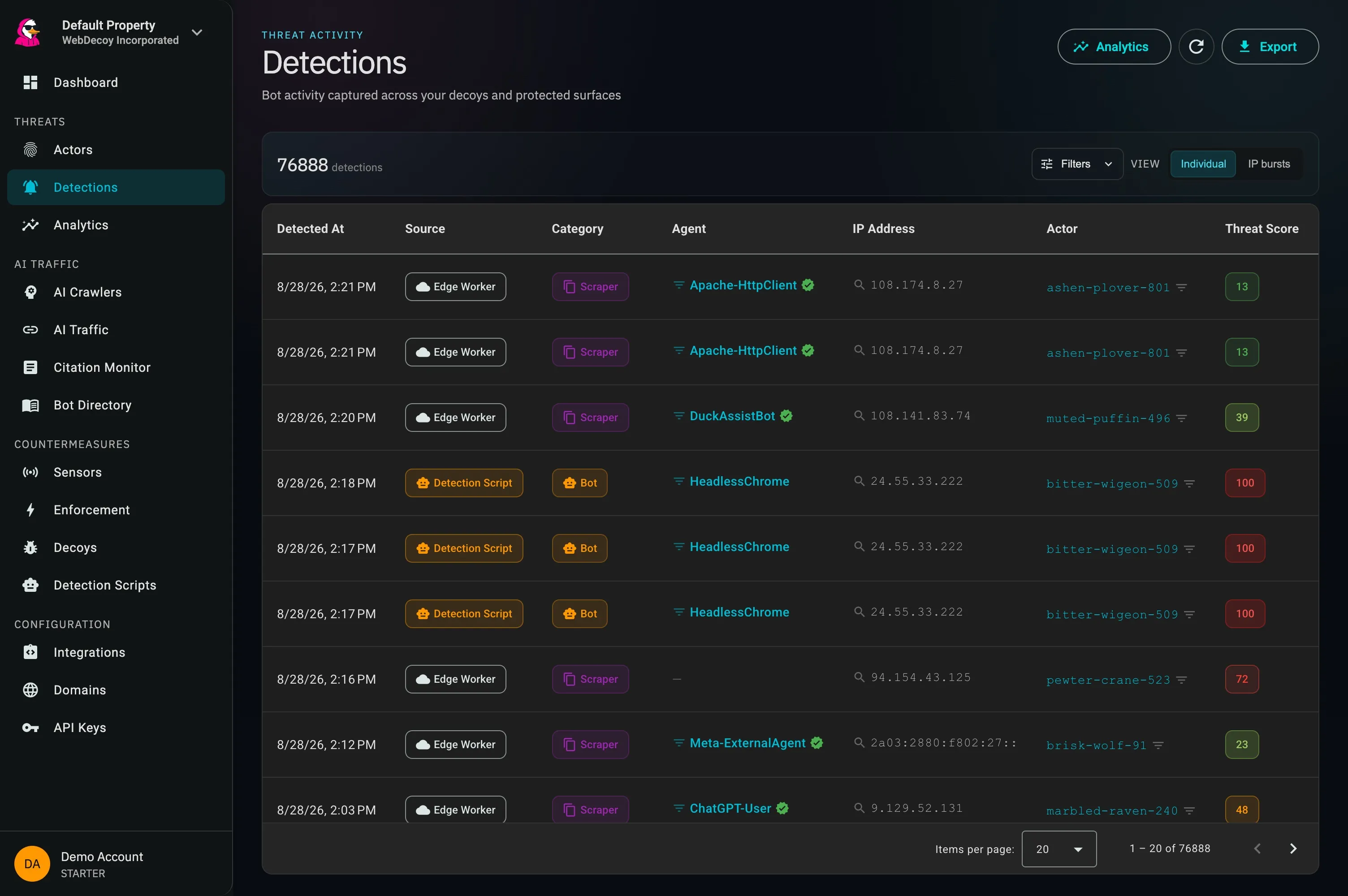
Actual WebDecoy interface. Product views shown with recorded traffic.
How it fits
Add browser detection to signup and login journeys. Verify CAPTCHA or clearance results on the server before protected actions; a widget alone is not an authorization check.
Explore F***CaptchaDeploy decoy endpoints outside real customer workflows. Inspect the requested path and captured event to distinguish a concrete probe from a general increase in traffic.
Explore endpoint decoysBegin in monitor mode, review evidence, and connect approved responses to supported WAF or application controls. Send detections to existing incident workflows through webhooks.
Explore enforcement and responseDeployment
Use the Node SDK for application integration, a browser tag for session signals, and supported edge enforcement where appropriate. Choose route-level controls so public documentation and product discovery can remain accessible.
Choose a plan for your deployment. View platform pricing.
Before you start
No. Keep authentication, authorization, rate limits, and account recovery controls. WebDecoy adds evidence about automated activity and decoy interactions that your application or security team can use alongside those controls.
A browser tag cannot observe a client that never executes it. Add Edge Sensor on a supported Cloudflare deployment or server-side integration for the request paths you need to observe.
Yes. Start in monitor mode, inspect detections, and compare them with application activity. Enable enforcement only after choosing supported response targets and reviewing the evidence and expected effect on your routes.
WebDecoy for SaaS & Software