
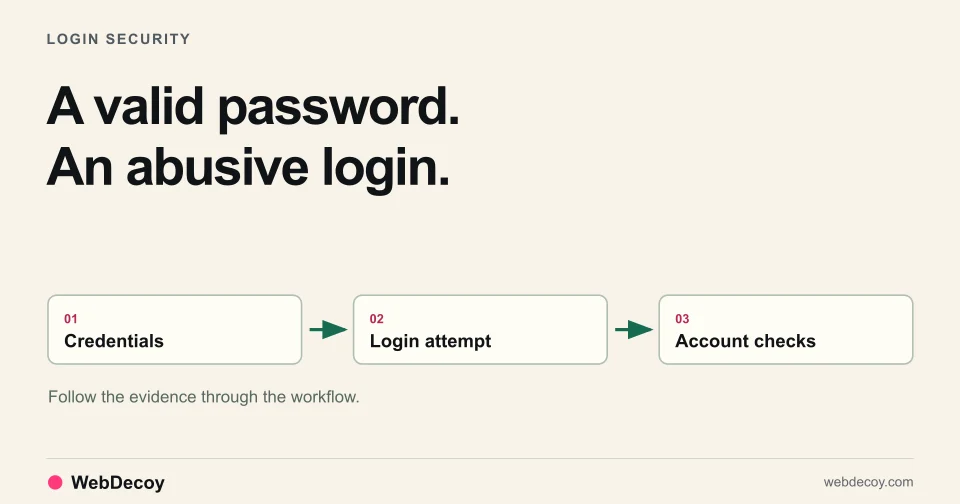
Credential Stuffing Attacks: Detection & Prevention Guide
See how credential stuffing attacks work, which tools and proxies attackers use, and how to detect and prevent account takeover at the login endpoint.
securityOOPSpam filters form spam but can't detect AI scrapers or headless browsers. Learn why behavioral analysis beats spam filters.
Published · Updated
Form spam was the primary bot threat of the 2010s. You installed a spam filter, configured a threshold, and moved on. OOPSpam and similar services solved this problem effectively with ML-based text analysis.
Then came the AI explosion.
GPTBot started crawling your site to train ChatGPT. ClaudeBot harvested your content for Anthropic. Perplexity scraped your articles to power AI search. And sophisticated attackers began probing your APIs with credential stuffing and injection attacks at unprecedented scale.
Spam filters cannot detect any of this. They only see form submissions. Everything else: the scrapers, the crawlers, the API attacks, flows past them undetected.
This guide explains why traditional spam filtering falls short against modern threats and how honeypot-based detection provides the protection businesses actually need.
OOPSpam is a legitimate spam filtering service founded in 2017. It analyzes text content submitted through forms and returns a spam score (0-6). The service checks:
For WordPress contact forms, comment sections, and registration pages, this approach works. OOPSpam’s ML model identifies spam text patterns with reasonable accuracy, and its privacy-first design avoids the data collection concerns of services like Akismet.
OOPSpam’s genuine strengths:
If your only concern is “how do I stop spam comments on my WordPress blog,” OOPSpam is a reasonable choice.
The threat landscape has fundamentally shifted. Businesses now face:
Every major AI company deploys crawlers to harvest training data:
| Bot | Company | What It Takes | OOPSpam Detection |
|---|---|---|---|
| GPTBot | OpenAI | Web content for ChatGPT | None |
| ClaudeBot | Anthropic | Training data for Claude | None |
| Perplexity | Perplexity AI | Content for AI search | None |
| CCBot | Common Crawl | Datasets for AI research | None |
These bots do not submit forms. They crawl your pages, download your content, and disappear. OOPSpam never sees them because OOPSpam only analyzes form submissions.
The business impact is real: Your original content ends up in AI training datasets. AI-powered search engines summarize your articles instead of sending you traffic. Your competitive intelligence becomes publicly available through AI chat interfaces.
Attackers use leaked password databases to attempt logins across thousands of sites simultaneously. Modern credential stuffing:
OOPSpam might catch stuffing attempts if the username/password text patterns match spam signatures. But sophisticated attacks use real email addresses and common passwords, content that looks legitimate.
Attackers probe applications for vulnerabilities:
OOPSpam’s ML model is trained on spam patterns, not attack signatures. A SQL injection payload like admin' OR '1'='1 is not spam. It is an attack. OOPSpam may not flag it at all.
Modern bots are designed to evade ML detection:
ML-based spam filters work by pattern matching. When bots are specifically designed to not match spam patterns, they succeed.
Honeypot-based detection solves these problems through a fundamentally different approach.
Instead of trying to identify bots by analyzing their behavior (error-prone), honeypots create traps that only bots trigger:
When something triggers a honeypot, you know with certainty it is a bot. There is no ML confidence score, no threshold tuning, no false positive risk.
| Approach | Detection Method | False Positive Rate | Bot Types Detected |
|---|---|---|---|
| ML Spam Filter | Pattern matching on content | Variable (ML inherent) | Form submissions only |
| Honeypot | Trap triggering | ~0% (by design) | All bot traffic |
This is not a marginal improvement. It is a categorical difference in reliability.
Honeypot-based platforms like WebDecoy detect:
Web Scrapers and Crawlers:
API Attacks (via Endpoint Decoys):
Sophisticated Bots:
Endpoint Decoys are fake API endpoints that act as honeypots for attackers. This capability does not exist in spam filtering services.
You deploy fake endpoints at paths attackers commonly probe:
/api/admin/login     → Catches credential stuffing
/api/users/export    → Catches data exfiltration
/api/config          → Catches reconnaissance
/graphql             → Catches introspection queries
/.env                → Catches config file hunting
When attackers hit these endpoints, WebDecoy:
When an attacker probes a fake login endpoint, your webhook receives a compact event. Illustrative example (values made up; the shape follows the webhook docs):
{
  "event": "detection",
  "timestamp": "2026-07-15T10:30:00Z",
  "detection": {
    "id": "det_abc123",
    "decoy_id": "decoy_uuid",
    "organization_id": "org_xyz789",
    "ip_address": "185.x.x.x",
    "user_agent": "python-requests/2.31.0",
    "bot_score": 92,
    "timestamp": "2026-07-15T10:30:00Z",
    "rules_enforced": false,
    "source": "endpoint"
  },
  "metadata": {}
}
The full detection, fetched by its id, carries the captured body, the matched attack signatures (here, SQL injection in admin' OR '1'='1), enrichment, and its MITRE ATT&CK tactic.
OOPSpam returns: { "Score": 4, "Details": {...} }
The difference in actionable intelligence is stark.
Modern security operations require integration with existing tools. Spam filters were not designed for this.
OOPSpam integrates via:
This works for form protection but provides no:
Honeypot platforms integrate with your security infrastructure:
| Integration | Purpose |
|---|---|
| Splunk | Detection events streamed through the HTTP Event Collector |
| CrowdStrike Falcon LogScale | Detection event forwarding |
| Datadog | Detection events sent as logs |
| Cloudflare WAF | IP blocks and actor fingerprint rules at the edge |
| AWS WAF | Managed IP set and fingerprint rule updates |
| Fastly, Vercel, Netlify | Blocking at the edge on those platforms |
| Slack and webhooks | Notifications and custom automation |
Every WebDecoy detection carries one MITRE ATT&CK tactic, for example:
This enables SOC teams to correlate honeypot detections with other security events using the same threat language.
AI scraping is not a future concern. It is happening now at massive scale.
Major AI companies crawl the web continuously:
Blocking AI bots via robots.txt has problems:
Honeypots solve the AI scraper problem:
When GPTBot follows a honeypot link, you know OpenAI is scraping your content. Even if they later update their crawler to avoid detection. The honeypot provides ground truth that robots.txt cannot.
If you are currently using OOPSpam and recognize the need for broader protection, migration is straightforward.
Moving to WebDecoy provides:
You still get form protection:
The difference is scope. WebDecoy protects your entire application, not just form submissions.
Total setup time: Under 30 minutes.
OOPSpam solved the form spam problem of 2017. It continues to work for that specific use case.
But the threat landscape has evolved. AI scrapers are harvesting content at unprecedented scale. Attackers are probing APIs with credential stuffing and injection attacks. Sophisticated bots are designed to evade ML detection.
Spam filters cannot address these threats. They only see form submissions. Everything else: the AI crawlers, the API attacks, the sophisticated bots, passes through undetected.
Honeypot-based detection provides the comprehensive protection modern businesses need:
The question is not whether you need bot protection beyond spam filtering. The question is whether you will implement it before or after AI companies finish training on your content.
Start free with WebDecoy and see what honeypot-based detection catches that spam filters miss.
Read the full OOPSpam vs WebDecoy comparison for detailed feature analysis.
See how credential stuffing attacks work, which tools and proxies attackers use, and how to detect and prevent account takeover at the login endpoint.
security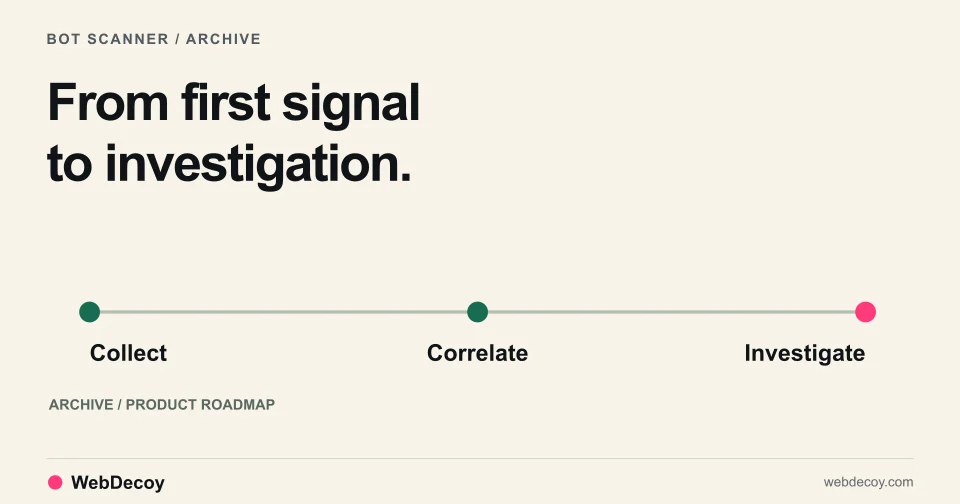
Introducing Bot Scanner: behavioral analysis and AI crawler detection. Learn our 6-week product roadmap.
security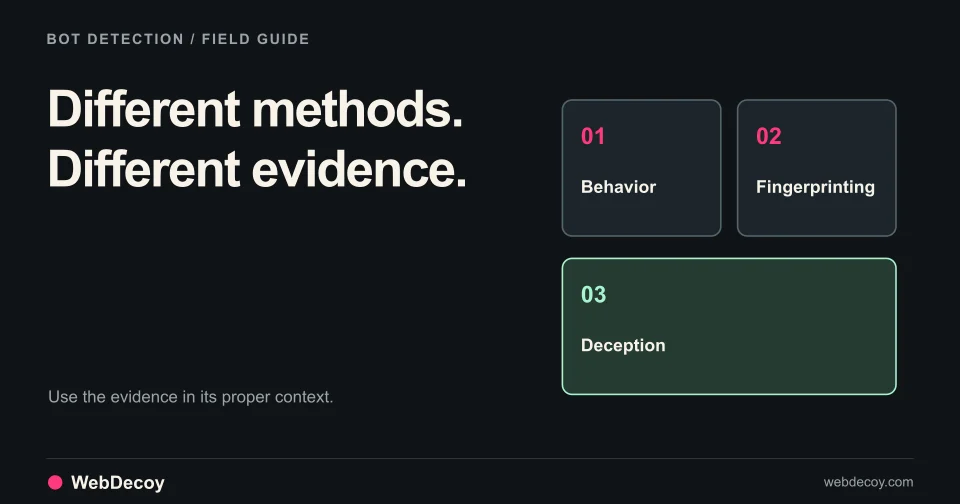
Master AI-powered bot detection with ML, behavioral analysis, honeypots, and implementation best practices for protecting applications.
securityLike this post? Share it with your friends!
Get a personalized demo from our team.